
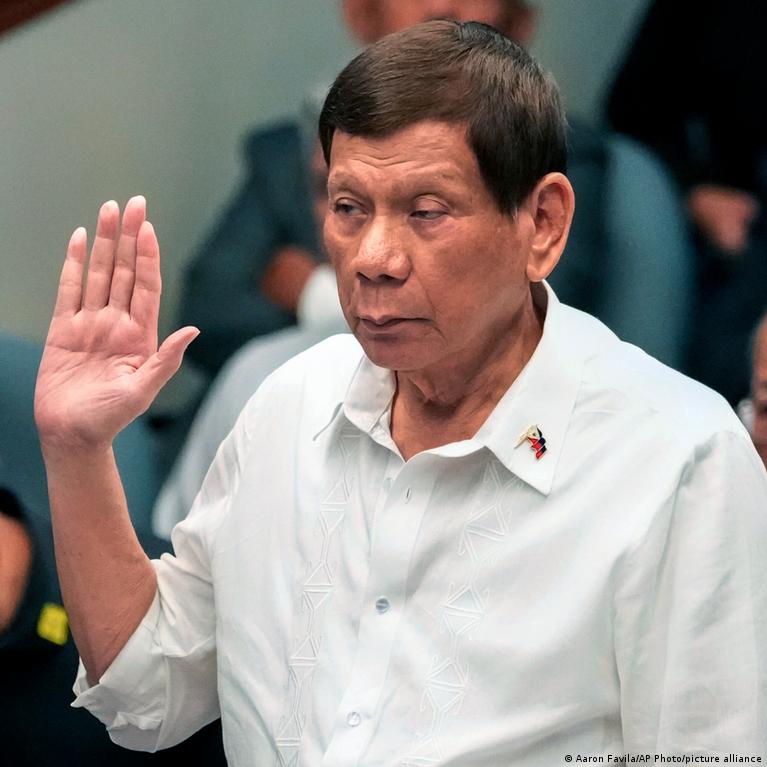
Philippines: Rodrigo Duterte faces ICC over deadly drug war
Paquito Mejos was one of the thousands of people who fell victim to former Philippine President Rodrigo Duterte’s “war on drugs”. The exact number of people killed between 2016 and 2022 remains unknown: The Philippine police say up to 7,000 people, while HRW, Amnesty International, as well as the International Criminal Court (ICC) in The Hague estimate up to 30,000 fatalities.
While the Philippine police say up to 7,000 people were killed, official estimates from global bodies pinpoint around 30,000 deathsImage: Reuters/E. De Castro
ICC: “Crimes against humanity”
The ICC accuses the former Philippine president of crimes against humanity; he is alleged to have been involved as an “indirect accomplice” in the planning and implementation of systematic killings.
Investigators cite at least 78 cases of murder and attempted murder in which they hope to prove his direct involvement. In addition, he is said to have incited police officers and hired killers to “neutralize” suspected criminals.
The current preliminary proceedings at the ICC serve to determine whether there is sufficient evidence for a main trial; a decision on this is expected in May 2026. This would make Rodrigo Duterte the first former head of state from Asia to face trial in The Hague.
Relief for wives of Duterte’s drug war victims
To view this video please enable JavaScript, and consider upgrading to a web browser that supports HTML5 video
The rise from Davao to Manila
Rodrigo’s political career started in Davao on the southern Philippine island of Mindanao. Until the 1980s, Davao was considered one of the most dangerous cities in the Philippines. Murders, drug crimes, robberies, and shootouts between rival gangs were commonplace.
However, this changed during the 22-year tenure of Rodrigo Duterte as mayor, during which he gained a reputation as a relentless crime fighter. Duterte declared a “zero tolerance policy” and essentially gave the police carte blanche to use lethal force when suspects resisted arrest. He is even said to have collaborated with death squads, the notorious “Davao Death Squads.” According to reports, between 1998 and 2015, these groups executed more than 1,400 people — including petty criminals, drug dealers, and even street children — without trial.
While human rights organizations expressed outrage, Duterte became enormously popular among the local population: Under his leadership, Davao was transformed into one of the safest and most economically prosperous cities in the Philippines. Nicknamed “The Punisher,” he ran in the 2016 Philippine presidential election and won by a landslide.
While watchdogs decried human rights violations, the people of Davao celebrated their mayor for his crackdown on drugs and violenceImage: Michael Runkel/robertharding/picture alliance
Martial slogans and deadly police brutality
As president, Duterte continued his “war on drugs” throughout the country. Although some suspected cartel bosses also fell victim to his campaign, it was mainly petty criminals, drug users, and even completely innocent bystanders who were killed, especially in the impoverished neighborhoods of Manila and other cities.
Time and again, his statements in this context caused international outrage. “If you know someone who is addicted, go and kill them,” he urged slum residents in Manila shortly after his inauguration in July 2016. “In Davao, I did it myself. Just to show the boys (from the police): ‘If I can do it, why can’t you?'” he stated in a speech in December 2016.
Particular consternation erupted when some critics compared his anti-drug war to the crimes of National Socialism. However, Duterte took up the comparison and stated that Hitler had “massacred millions of Jews. Well, there are three million drug addicts here. I would like to slaughter them all,” he said.
According to a report by Amnesty International, police officers allegedly received unofficial bounties for every suspect they killed. These bounties were not paid for mere arrests.
Even though Duterte is on trial and the Philippines have a new president, many of Duterte’s regulations remain in forceImage: DW
The war on drugs goes on
In June 2022, after six years in office, Rodrigo Duterte stepped down. The new election winner was, of all people, Ferdinand Marcos Jr, the son of former dictator Marcos. The fact that he had Duterte arrested in March 2025 and transferred to The Hague has less to do with a change of heart in the fight against drugs than with the new president’s desire to get rid of his biggest political rival.
After all, the war on drugs has never been officially called off, even under Duterte’s successor. Numerous regulations from the Duterte era remain in force. According to Amnesty International, the number of extrajudicial killings has declined slightly.
Nevertheless, they continue to occur. And while the Philippine government claims to have broken up several drug rings and destroyed laboratories, critics paint a rather devastating picture: as violence and brutality increased in the Philippines and the rule of law was increasingly undermined, the drug cartels were able to adapt and reorganize their structures; the government failed to permanently remove “shabu” and other drugs from circulation.
Philippine cafe keeps alive memory of ‘drug war’ victims
To view this video please enable JavaScript, and consider upgrading to a web browser that supports HTML5 video
This article was originally published in German.
Thomas Latschan Author and editor with a focus on global politicsSend us your feedback
Vezi articolul la: DW