
Ukraine updates: Russian invasion reaches 4-year anniversary
EU leaders travel to Ukraine to commemorate the fourth anniversary of the war
Below are the latest headlines, background and analysis from Russia’s war in Ukraine on Tuesday, February 24.
Skip next section WATCH: A timeline of 4 years of war in Ukraine02/24/2026February 24, 2026
WATCH: A timeline of 4 years of war in Ukraine
Nick Connolly
Four years after Russia’s invasion of Ukraine, Russia’s advance has settled into a slow war of attrition.
A new report warns that the number of soldiers killed, injured or missing on both sides could soon hit 2 million.
Four years of war in Ukraine: a timeline
To view this video please enable JavaScript, and consider upgrading to a web browser that supports HTML5 video
https://p.dw.com/p/59JGbSkip next section Germany’s Merz: ‘Ukraine’s fate is our fate’02/24/2026February 24, 2026
Germany’s Merz: ‘Ukraine’s fate is our fate’
German Chancellor Friedrich Merz joined other world leaders in marking the fourth anniversary of Russia’s invasion of Ukraine, calling it a daily “nightmare for Ukrainians” and everyone in Europe.
Like other European allies, Merz called for collective action, saying “Ukraine’s fate is our fate” and declaring that the war could only be ended through shared effort.
https://p.dw.com/p/59JAKSkip next section Macron: Moscow’s invasion a ‘triple failure for Russia’02/24/2026February 24, 2026
Macron: Moscow’s invasion a ‘triple failure for Russia’
French President Emmanuel Macron on Tuesday blasted Russia’s illegal invasion of neighboring Ukraine on Tuesday as world leaders marked the start of year five of the conflict.
“This war is a triple failure for Russia: Militarily, economically and strategically,” wrote Macron in a post on X.
After acknowledging Ukraine’s perseverance, Macron wrote, “One day, Russians will grasp the enormity of the crime committed in their name, the hollowness of the pretexts invoked, and the long-term, devastating effects on their own country.”
Macron also claimed that more than 1.2 million Russian soldiers had been killed or injured since Putin ordered the invasion.
Beyond noting that this is the “highest number of Russian combat casualties since the Second World War,” Macron said the war “has strengthened NATO, whose expansion it sought to prevent, united Europeans whom it wanted to weaken, and laid bare the fragility of an imperialism from another age.”
Despite concern about wavering European support after four years of full-scale war, Macron warned, “To those who think they can count on our fatigue: they are mistaken.”
https://p.dw.com/p/59J3pSkip next section READ: Ukrainian resilience remains strong as war enters fifth year02/24/2026February 24, 2026
READ: Ukrainian resilience remains strong as war enters fifth year
Daria NynkoUkrainians are forced to shelter in subway stations when Russia swarms Kyiv with attack dronesImage: Dan Bashakov/AP Photo/picture alliance
Russian attacks have made an already harsh winter even harder to endure for Ukrainians, yet after four years of war, most remain determined to tough it out.
A poll published by the Kyiv International Institute of Sociology (KIIS) found that despite massive Russian attacks on energy facilities that knocked out power, water and heat across the country in the dead of winter, 65% of those interviewed said they were prepared to tough it out as long as necessary. That number is up from 62% in September.
Read DW’s full report on how Ukrainians are getting through the harsh winter.
https://p.dw.com/p/59Iv6Skip next section EU, Baltic, Nordic leaders arrive in Kyiv in show of support02/24/2026February 24, 2026
EU, Baltic, Nordic leaders arrive in Kyiv in show of support
European Union leaders, accompanied by Baltic and Nordic counterparts, arrived in Kyiv Tuesday to underscore their commitment to supporting Ukraine as Russia’s invasion marks its fourth year.
In a post on the messaging app X, European Commission President Ursula von der Leyen on Tuesday said the trip was designed, “to send a clear message to the Ukrainian people and to the aggressor alike: We will not relent until peace is restored.”
Accompanied by EU Council President Antonio Costa, von der Leyen is scheduled to take part in a memorial ceremony in the Ukrainian capital, as well as touring a power plant damaged by Russian attacks and holding meetings with President Zelenskyy.
Beyond those politicians gathered in Kyiv, UK and French leaders have also organized a video conference of what allies have dubbed the “coalition of the willing.”
Numerous solidarity marches are also scheduled across Europe today to mark the grim milestone.
https://p.dw.com/p/59InmSkip next section Zelenskyy tells Ukrainians Putin has failed to achieve goals four years into invasion02/24/2026February 24, 2026
Zelenskyy tells Ukrainians Putin has failed to achieve goals four years into invasion
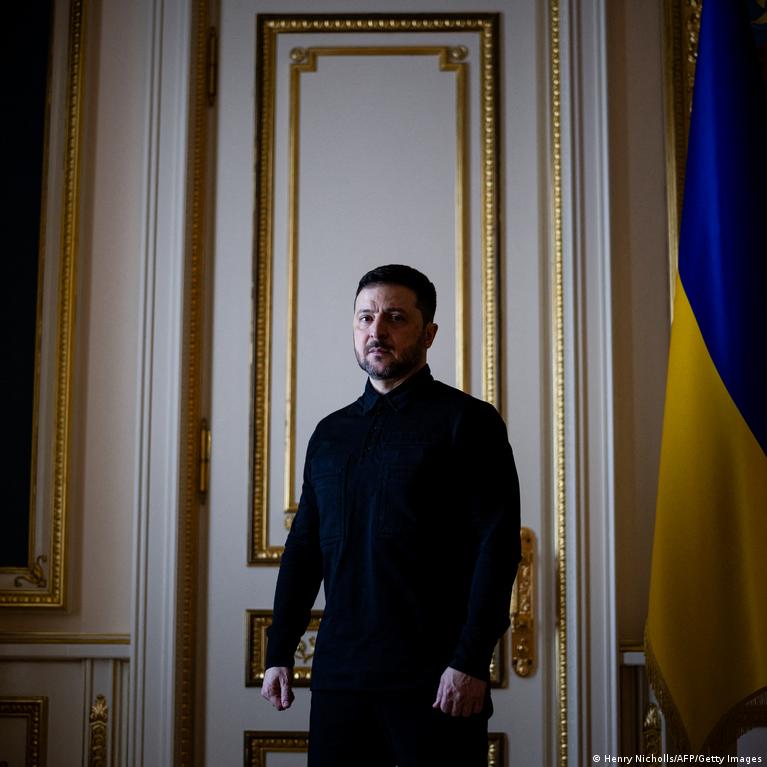
Ukrainian President Volodymyr Zelenskyy on Tuesday marked the four year anniversary of Russia’s invasion of his country with a televised speech in which he said Russian President Vladimir Putin had failed in his efforts to subjugate Ukraine.
“Putin has not achieved his goals. He has not broken the Ukrainian people. He has not won this war. We have preserved Ukraine, and we will do everything to achieve peace and to ensure justice,” said the Ukrainian leader.
Zelenskyy’s remarks are not unlike those made lately by Finnish President Alexander Stubb, who succinctly lists three major miscalculations on Putin’s part — saying he sought to make Ukraine Russian, now it is on a path to EU membership; he wanted to reduce the size of NATO, but instead it has only grown bigger due to his actions; and thirdly, he sought to project Russian power globally but has instead seen his country’s influence wane with the fall of Bashar Assad in Syria, the capture of Nicolas Maduro in Venezuela, and pressure being piled on Iran’s theocrats in their conflict with Israel and the US.
https://p.dw.com/p/59IfsSkip next section Fleeing war, Ukrainian women face ‘high rates’ of abuse in EU02/24/2026February 24, 2026
Fleeing war, Ukrainian women face ‘high rates’ of abuse in EU
Jon Shelton | Elizabeth Schumacher Editor
The EU Agency for Fundamental Rights (FRA) has reported that women who fled Ukraine for the safety of the EU after Russia launched its full-scale invasion four years ago face “high rates” of physical, psychological and sexual violence in the bloc.
The report, which calls for improved safeguards, says 2.5 million women and girls have been granted protective status by the EU since 2022.
“Despite the protections offered by the EU, many women suffer serious violations; others feel unsafe,” said FRA Director Sirpa Rautio. “EU member states must ensure that women receive protection, support and justice for what they have endured so that they can rebuild their lives.”
FRA says women face increased threat at home, noting that one-in-four had experienced physical or sexual violence inside Ukraine — often at the hands of invading Russian forces.
The report, compiled from a 2024 survey of over 1,200 Ukrainian women now living in the EU — mainly the Czech Republic, Germany and Poland, found that 62% had experienced violence since fleeing to the EU.
The report says half of Ukrainian women and girls experienced sexual harassment since arriving in the 27-member bloc and that 23% face higher than usual rates of online sexual harassment.
Almost one-quarter of all women and girls interviewed told FRA that they had received “potentially exploitative offers of transport, housing or work.”
Lastly, more than half of respondents (54%) say they have suffered abuse or insult when speaking Ukrainian in public, especially those women living in the Czech Republic and Poland.
The FRA report shows that women and girls rarely report such incidents to authorities.
It also highlights the fact that roughly one-third of women surveyed said they had no access to mental health services.
https://p.dw.com/p/59IcWSkip next section A Ukrainian soldier’s story: years of war and fading hope02/24/2026February 24, 2026
A Ukrainian soldier’s story: years of war and fading hope
Kostiantyn HoncharovKostiantyn Honcharov volunteered to serve in the armyImage: Vitalii Pavlenko/ArmyInform
DW correspondent Kostiantyn Honcharov joined the Ukrainian army in 2022.
He describes the grim front-line situation after four years of fighting.
Read the full report on his experience fighting against the Russian invasion.
https://p.dw.com/p/59HiISkip next section Germany’s top diplomat open to Russia talks but no further concessions02/24/2026February 24, 2026
Germany’s top diplomat open to Russia talks but no further concessions
German Foreign Minister Johann Wadephul said he was open in principle to talks with Russia that dealt with a sustainable peace in Ukraine, but said there would be no concessions.
“Ukraine must of course be the first to speak. But we are also ready to talk,” Wadephul said at the “Cafe Kyiv” forum hosted by the Konrad Adenauer Foundation in Berlin.
“But we will not arrive in Moscow and make further concessions. We will not do that,” he added. “If the shooting stops, if there is a serious willingness to talk, then we will certainly be involved.”
“But we are not begging him, to put it bluntly,” Wadephul said, referring to Russian President Vladimir Putin. “We expect that at some point one of the reasonable proposals will be accepted.”
Wadephul, rejected calls from some members of the centre-left Social Democrats to approach Putin with fresh proposals for a ceasefire.
“There is no shortage of communication channels. But a channel is useless if he does not want to talk,” Wadephul said.
Ukrainians hold firm as Russia’s war enters its fifth year
To view this video please enable JavaScript, and consider upgrading to a web browser that supports HTML5 video
https://p.dw.com/p/59IZVSkip next section Timeline of the war in Ukraine02/24/2026February 24, 2026
Timeline of the war in Ukraine
The four-year-long war saw initial gains by Russian forces fall apart, with Moscow refocusing its efforts on taking control of eastern Ukraine while launching waves of drone and missile strikes against civilian centers across the country. Here are some of the key dates from the war, according to German broadcaster ZDF:
- February 24, 2022: Russia launches full-scale invasion with land, air and missile attacks
- March 2, 2022: Russian forces take Kherson, close to the occupied region of Crimea
- March 25, 2022: Ukrainian troops push back Russian attempt to encircle Kyiv, Russia changes focus to eastern Ukraine
- April 2, 2022: Hundreds of bodies of civilians discovered after Russian forces leave the town of Bucha
- May 21, 2022: Russian forces take control of Mariupol after fierce fighting
- September 10, 2022: Ukrainian counteroffensive pushes Russian troops out of the Kharkiv region
- September 30, 2022: Russia illegally annexes Luhansk, Donetsk, Kherson and Zaporizhzhia despite not controlling the regions in their entirety
- November 9, 2022: Russian forces pull back from the city of Kherson
- 2023: War slows down with a bigger focus on drone and missile attacks
- May 10, 2024: Russia launches new campaign against Kharkiv, as a result German and US allow Ukraine to use weapons they provided against targets inside Russia
- August 6, 2024: Ukrainian troops launch surprise assault on Russian territory inside the Kursk region
- January 20, 2025: Russian forces make gains ahead of Donald Trump’s return to the White House
- November 20, 2025: US hands Ukraine peace plan that would see Ukraine give up more land and see Russian gains be recognized
- February 16, 2025: Ukraine retakes control of 63 square kilometers in the south of the country in five days
https://p.dw.com/p/59GzeSkip next section EU’s messages of support for Ukraine02/24/2026February 24, 2026
EU’s messages of support for Ukraine
European Commission President Ursula von der Leyen posted up a message of support for Ukraine as Russia’s full-scale invasion reached the four-year mark.
“Tonight, we adorn our European institutions with the colours of Ukraine. Two colours, carrying the spirit of courage. Two colours, burning with resistance. Four years into Russia’s full-scale war, these colours are shining brighter than ever. Slava Ukraini,” von der Leyen said in a post on X.
It was accompanied with a photo of the Commission’s headquarters in Brussels with a large national flag of Ukraine projected onto the building.
The European Commission X account also posted a simlar message, saying: “Tonight, the colours of Ukraine are illuminating our headquarters. They stand as a reminder of the courage and resilience of the Ukrainian people, and the enduring pain of a war that continues, after four years. Our commitment to Ukraine is unwavering.”
On Tuesday, von der Leyen and Antonio Costa, the president of the European Council, are expected in Kyiv.
They both said they would participate in a commemoration ceremony and visit a Ukrainian energy facility damaged by Russian strikes. Then, they will attend a meeting with President Volodymyr Zelenskyy.
They are also scheduled to participate in a video conference with Kyiv’s allies — the so-called “Coalition of the Willing,” which includes Britain, France, and Germany.
https://p.dw.com/p/59IYgSkip next section Russian authorities say explosive detonated near train station in Moscow02/24/2026February 24, 2026
Russian authorities say explosive detonated near train station in Moscow
Savyolovsky railway station is located in the northern part of Moscow. It primarily serves northbound suburban trainsImage: Pavel Seleznev/ITAR-TASS/imago
Russia’s Interior Ministry said that a man detonated an explosive device next to a police car in central Moscow, killing both himself and a police officer and injuring two others.
The ministry said the attack took place at about 12:05 a.m. (2105 GMT) on Savyolovsky railway station square.
The Moscow branch of the Interior Ministry said that the unidentified assailant approached a traffic police vehicle and then detonated a device.
An investigation into the circumstances of the attack has been launched, according to Russia’s Investigative Committee.
https://p.dw.com/p/59IYKSkip next section Europe has the power but not the political will, Ben Hodges tells DW02/24/2026February 24, 2026
Europe has the power but not the political will, Ben Hodges tells DW
Ines Pohl
Four years after Russia’s full-scale invasion of Ukraine, the war is far from over — and its outcome remains uncertain.
In an exclusive interview, DW asked retired US General Ben Hodges what went wrong and what’s next.
Ben Hodges: Europe has the power but not the political will
To view this video please enable JavaScript, and consider upgrading to a web browser that supports HTML5 video
https://p.dw.com/p/59GjKSkip next section Russia’s war in Ukraine: 4 years in numbers02/24/2026February 24, 2026
Russia’s war in Ukraine: 4 years in numbers
Reliable figures for casualties and death tolls from the war in Ukraine are notoriously difficult to come by, but four years of conflict have provided enough material for estimations. Here are some of the key figures from the war:
- 1.2 million casualties, including 325,000 deaths on the Russian side between February 2022 and December 2025, according to the Center for Strategic and International Studies
- 500,000-600,000 casualties, including 140,000 deaths on the Ukrainian side during the same period
- 14,999 civilian deaths, with more than 40,600 casualties, according to the UN Human Rights Monitoring Mission, which itself admits this is probably an underestimate
- 763 children killed, according to the UN
- Russia controls 19.4% of Ukrainian land, according to the Institute for the Study of War, up from 7% before February 2022
- Russian forces only gained 0.79% of Ukrainian territory last year amid a grinding war of attrition
- Foreign aid to Ukraine fell by 13% last year in comparison to the 2022-2024 average
- 5.9 million Ukrainians have left their country, the vast majority headed to Europe, 3.7 million have been displaced within Ukraine
https://p.dw.com/p/59GiwSkip next section Welcome to our coverage02/24/2026February 24, 2026
Welcome to our coverage
Alex Berry with Reuters, AFP, dpa, AP | Dmytro Hubenko Editor
You join us as the Russian full-scale invasion of Ukraine enters its fifth year.
On February 24, 2022, Russian troops attacked Ukraine from several directions, including from Belarus.
Russian forces, however, first entered Ukraine in February 2014 that resulted in them taking control of the Ukrainian peninsula of Crimea and carrying out an illegal annexation.
There have been multiple attempts to secure a ceasefire, including most recently under the auspices of US President Donald Trump, but no end appears to be in sight.
https://p.dw.com/p/59GiBShow more postsJon Shelton Writer, translator and editor with DW’s online news team.Kieran Burke News writer and editor focused on international relations, global security and law enforcement.Alex Berry Writer and Editor in DW’s online newsroom.Send us your feedback
Vezi articolul la: DW